
Short answer: an eSIM and a physical SIM connect you to the same networks at the same speeds. The difference is handling: an eSIM is downloaded and can be installed before you fly, while a physical SIM is a card you buy, insert and can lose. For travel, an eSIM usually wins if your phone supports it and is unlocked.
The eSIM vs physical SIM question used to be about which phones had which. Most recent phones now have both, and some newer ones have no SIM tray at all. What matters is which one suits your trip.
This comparison covers what differs, where each one wins for travellers, and the downsides of eSIM. Facts are from Apple and Google support pages, and Aynet prices are from our catalogue, all checked on 29 September 2026.
What is the difference between an eSIM and a physical SIM?
A physical SIM is a removable plastic card; an eSIM is a chip built into the phone that holds plans you download. Both store the same kind of network credentials, so the network treats them the same way.
| eSIM | Physical SIM | |
|---|---|---|
| Form | Chip inside the phone | Removable card |
| How you get a plan | Scan a QR code or tap to install | Buy a card, insert it |
| Set up before you travel | Yes, at home on Wi-Fi | Only if bought before the trip |
| Plans per phone | Several stored (iPhone: eight or more) | One per slot |
| Move to another phone | Transfer or reissue, depends on provider | Pop it out and in |
| Can be lost or damaged | No | Yes |
| Needs an eSIM-capable phone | Yes | No |
| Signal and speed | Same network, same speed | Same network, same speed |
If you want the basics first, read what is an eSIM.
Is an eSIM better than a physical SIM for travel?
For most trips, yes, because you can buy and install it at home and land connected. You skip the airport SIM kiosk and keep your home SIM in the phone for calls and texts. No fingernail-sized card to swap on a moving plane, either.
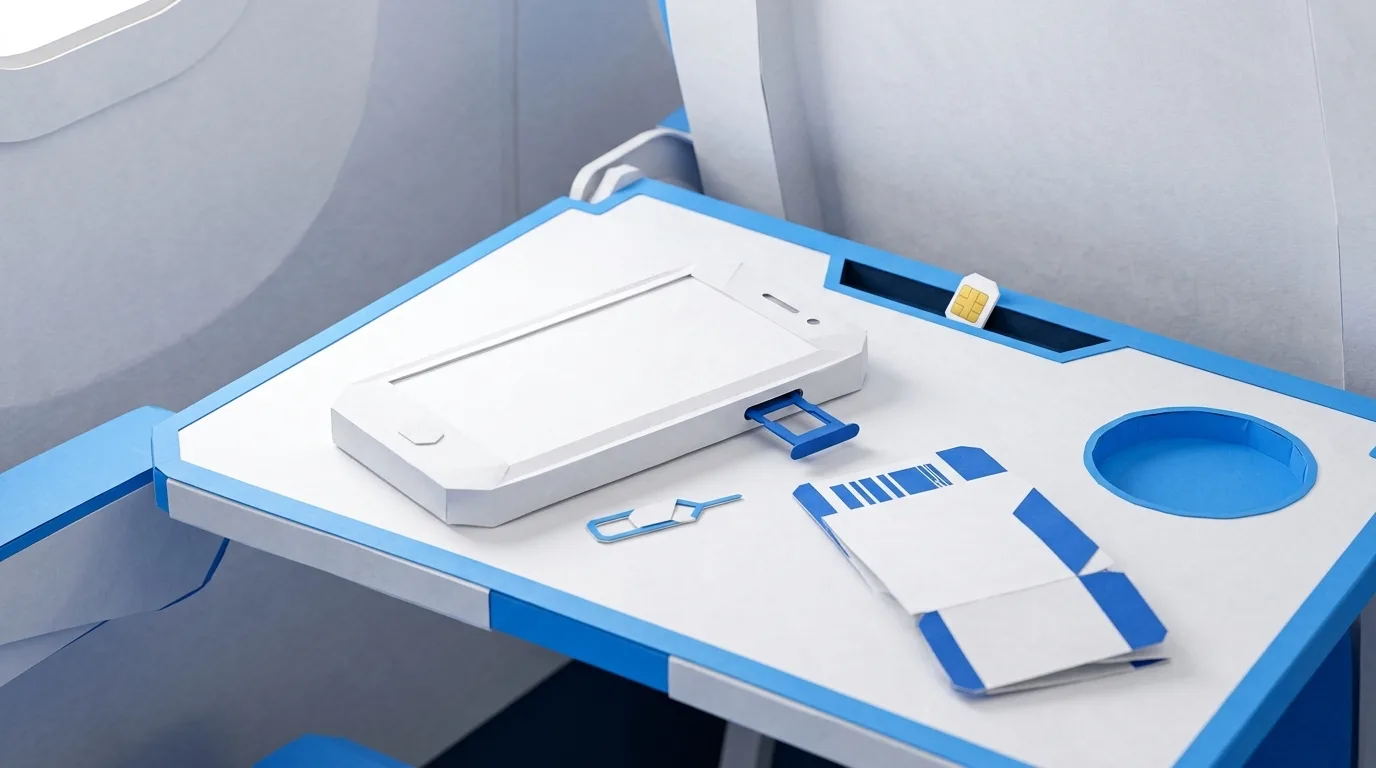
A physical SIM still wins in a few cases, set out in the next section.
When does each one win?
Pick the column that sounds like your trip:
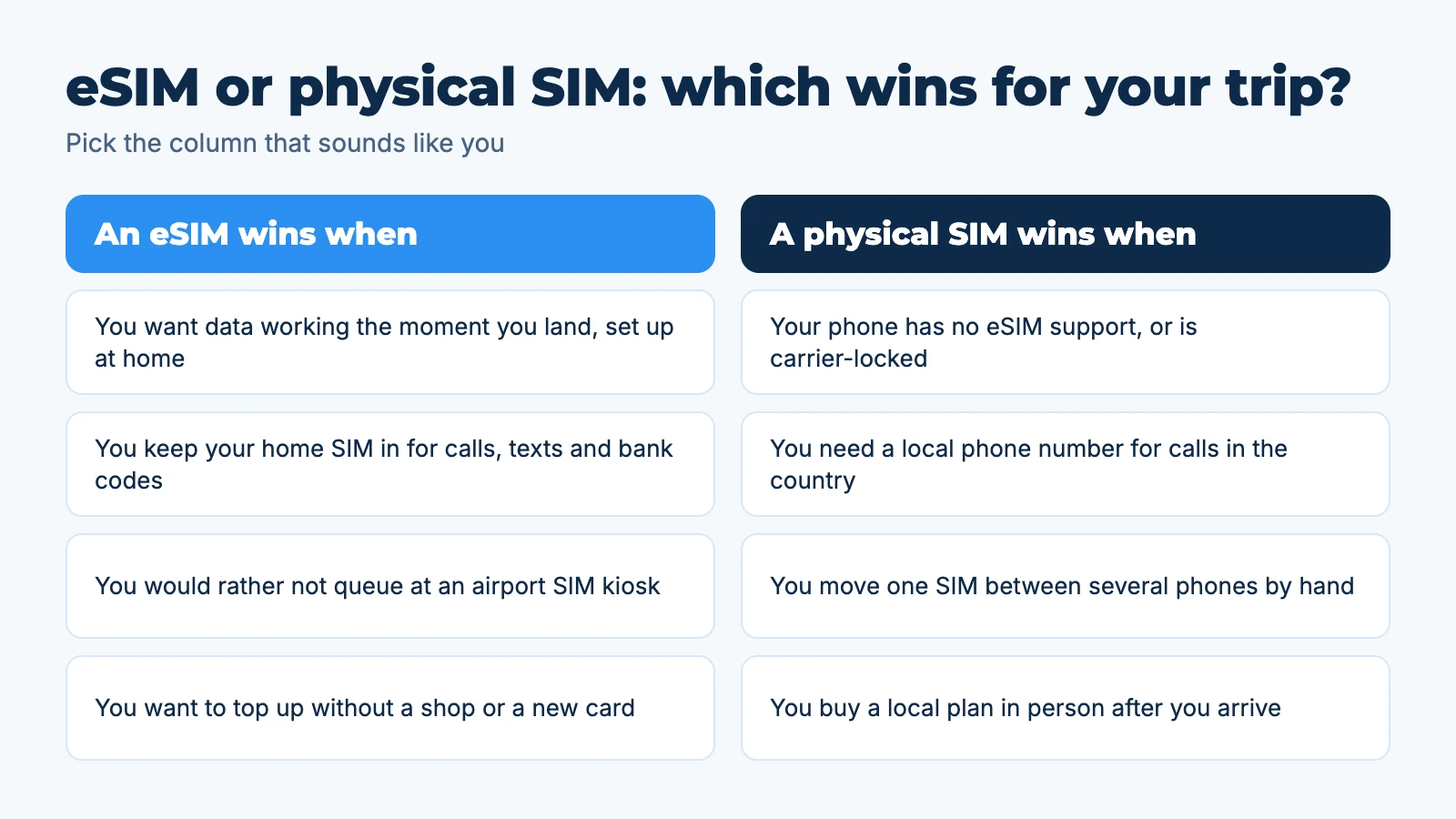
An eSIM makes more sense when you want data working as you step off the plane and your home SIM left in for bank codes. Topping up from your phone instead of a shop helps too.
A physical SIM makes more sense when your phone has no eSIM or is locked to a carrier, when you need a local number for calls inside the country, or when you move one SIM between several phones.
In short: if your phone supports eSIM and is unlocked, use an eSIM for data and keep your physical SIM for your home number.
What are the downsides of an eSIM?
Check these before the trip:
- Your phone has to support it. Older and budget phones may have no eSIM. Check with the eSIM compatibility checker.
- The phone must be unlocked, because a carrier-locked phone refuses other networks' eSIMs. Here is how to check if your phone is unlocked.
- Installing needs Wi-Fi or data to download the profile, so do it at home.
- If the phone dies, the eSIM is stuck in it. With a card you can move the SIM to a spare phone. With an eSIM you need a transfer or a new profile from the provider.
- Deleting it can be permanent: a deleted travel eSIM usually cannot be reinstalled from the same QR code.
- Travel eSIMs are usually data only, with no local phone number or SMS.
None of these is a reason to avoid eSIM, but the first two are reasons to check your phone before you buy.
Is an eSIM faster or does it get a better signal?
No. Signal strength and speed depend on the network, the coverage where you are, and your phone's radio, not on whether the SIM is a card or a chip. An eSIM on a given network performs the same as a physical SIM on that network.
What does change speed is the plan: which network it uses and whether it supports 5G. Aynet names the network on every plan before you buy. On a Turkey plan, for example, the card lists Vodafone Türkiye, and the Max tier adds Türk Telekom.
What about the phones that have no SIM slot?
These phones take eSIM only. Apple sells iPhone 14 and later as eSIM only in the US, the iPhone Air as eSIM only everywhere, and iPhone 17 models as eSIM only in several countries, including the US, Canada, Mexico and Japan. Google's Pixel 10 phones sold in the US, except the Pixel 10 Pro Fold, take eSIM only.
If you travel with one of those, the question is settled: you need an eSIM for travel data.
Is an eSIM more secure than a physical SIM?
In one practical way, yes: a thief cannot pull an eSIM out of your phone and put it in another device, which they can do with a card. Both store your credentials on a secure chip, and a physical SIM can be protected with a SIM PIN.
How much does a travel eSIM cost compared with a local SIM?
Local SIM prices vary by country and shop, so compare against the specific plan you would buy. As a reference point, Aynet plans for Egypt and Morocco start at €4.99 for 1 GB over 7 days, VAT included (catalogue, 29 September 2026). Larger plans are listed on each destination page with the network named.
The bigger saving is usually against home roaming. If you are with a UK network, see EE roaming charges vs a travel eSIM for a worked example.
Want a plan picked for you? Describe your trip to Aynet and get one recommendation, with the network and the limits shown before you pay.
FAQ
Which is better, eSIM or physical SIM?
An eSIM is better for most travellers, because you can install it before you fly and keep your home SIM in the phone. A physical SIM is better if your phone lacks eSIM or is carrier-locked, or if you need a local phone number. Signal and speed are the same on the same network.
Can I have both an eSIM and a physical SIM?
Yes. Dual SIM phones run a physical SIM and an eSIM at the same time. Most travellers keep the home SIM for calls and texts and use the eSIM for mobile data.
Is eSIM signal weaker than a physical SIM?
No. Signal depends on the network and your location, not on the SIM format. Two phones on the same network, one with an eSIM and one with a card, get the same signal.
Can I switch from a physical SIM to an eSIM?
Often, yes, for your home line: many carriers can convert your number to an eSIM, and Apple's eSIM Quick Transfer can move lines between iPhones on iOS 18.4 or later. For travel you do not need to convert anything; you add a travel eSIM alongside your SIM.
What happens to my eSIM if I lose my phone?
The eSIM stays on the lost phone. Ask your carrier to block the line and issue a new eSIM for your replacement phone. For a travel eSIM, contact the provider, who may be able to reissue it.
Sources: Apple, About eSIM on iPhone, Apple, eSIM-only iPhone models, Apple, Dual SIM with an eSIM, Google Pixel, Use an eSIM, Aynet catalogue, 29 September 2026. All checked 29 September 2026.
- #Comparison
- #Esim Basics
關於作者
Taha Latif
Design and analytics
Leads design and analytics at Aynet, from the trip planner to the eSIM install flow.